Vincent TAC 88, Tubes with nostalgia
WHAT MAKES TUBES SPECIAL
- Vincent gets the very best out of the well-known KT 88, in an attractive retro design.
- Price: €1,520
- Specialists' rating: 6
- Text: Ramon Sendra
The "old" vacuum tubes refuse to disappear. Having already analyzed another Vincent design based on a tube preamp in the last issue, we now receive another "retro" proposition, both in looks and in technology.
The TAC 88 (its only difference from the lower TAC 34 model is that our guest uses KT 88 tubes) reminds us of those designs of yesteryear, revived today, that give the tubes pride of place. It is not a new visual design, nor does it bring anything new in terms of technology. That is not its main challenge. In fact, the aim is to cater efficiently to this renewed interest in tubes. And what better way to make good products than by borrowing heavily from the best tube-based designs of a few decades ago. It is therefore understandable that this look is shared by several manufacturers.
But let's focus on our guest. It is quite heavy, not only because of the transformer but also because of the chassis, which is designed to improve the unit's own stability and prevent any unwanted interference or distortion.
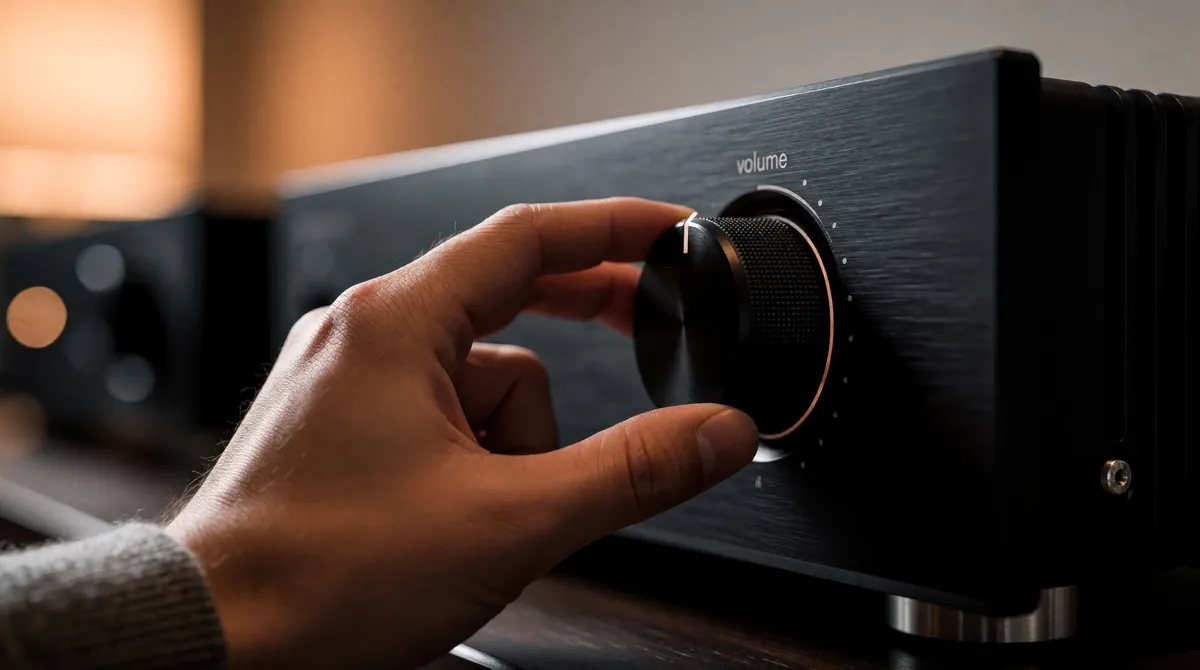
Following the same principle, the only controls available are volume and input selection, in this case among four inputs: CD, Auxiliary, Tuner and Tape. All of them are unbalanced analog stereo audio inputs.
On the rear panel we find three binding posts per channel: two positive and one negative. We choose the corresponding pair according to the impedance of our loudspeakers (4 or 8 ohms).
On the front panel, as the picture shows, there are only two knobs (volume and input selection) and a simple on/off switch. Nothing else. That is to say, there is no remote control, for example, nor the usual treble and bass controls found on other high-end electronics. According to the manufacturer, the fewer the "extras", the greater the sonic reliability. Perhaps.
The unit actually comes with a cage that protects the tubes, as they get hot during operation. In addition, the grease from our fingers can considerably shorten their service life. It is best not to touch the tubes unnecessarily.
The highlight of this model is its use of the KT88, a tube renowned worldwide for its characteristics. As it should be, it is configured in triode mode which, although it reduces the final power output, achieves greater efficiency. Newcomers will be surprised by the low power output of this type of unit (50 W RMS per channel for our guest), but the reality is that what really drives the loudspeakers is current, not a greater or lesser number of watts.
Of course, they need loudspeakers with good sensitivity (most models), but they are not recommended for use with very hard-to-drive speakers.
In our case we used a Marantz DV7600 player as the source and a pair of Audiovector Mi3 Super loudspeakers wired with Supra cables.
With this setup I can confirm that, right from the start, the current delivery of this TAC 88 is masterful. It has nothing to envy in other, more conventional amplifier combinations (even the Vincent SP-993 I reviewed in the last issue).
The bass response is superb, perfectly complemented by coherent midrange reproduction that gives way to treble that is not at all shrill. The Mi3 Supers delivered a powerful and pleasant sound, free of any listening fatigue.
For example, Luis Robisco's Spanish guitar on Tiempos shows all its potential and presence, without the large dynamic leaps managing to overwhelm this TAC 88. On the contrary, it handles every change perfectly with considerable speed of attack.
Silje Nergaard's deep voice appears focused right where it should be, in the center, while the performance of the other instruments is respected: deep bass for the double bass, excellent midrange for the piano, and so on. With orchestral music all of the above is confirmed: good dynamic response, very good instrument focus and absolute respect for the three-dimensionality of the stereo image.
You can spend hours sitting in front of your speakers enjoying both the music and the retro looks of this Vincent TAC 88. But what really matters is the former. Many enthusiasts will find in this model a perfect ally for their love of music.
An excellent design in every respect, capable of delivering a very worthy, "tube-like" sound for those who resist the "coldness" of transistors.
WHAT MAKES TUBES SPECIAL
Those who know tubes well will appreciate the advantages of this old-school electronics. Those who don't should know a few things. For example, this TAC 88 comes with a standard cage that protects the tubes from accidental contact. Apart from the fact that they get hot during operation, touching them with your fingers leaves them coated in grease. When heated, this grease impairs the physical properties of the glass, reducing its ability to withstand the tube's vacuum: and so we shorten its service life. You should also understand that they do not last forever. Quite the opposite. From time to time (over periods measured in years) they will need to be replaced with new ones (and we must be careful when handling them).
As we can see in the specifications, harmonic distortion is rated at below 1%, an "abnormal" value for a high-end product. In fact, what people love about tubes is precisely the "warmth" they lend to the sound, almost imperceptible but identifiable. For measurement purposes, this "warmth" is distortion (the original sound will differ by up to 1% from the amplified sound). THD is not always a sign of "malfunction".
Vincent TAC 88, Tubes with nostalgia
Specifications
Power: 2 x 55 W RMS into 8 ohms. Frequency response: 10 Hz to 50 kHz (+/- 1.5 dB). Total harmonic distortion: Less than
1% (1 kHz, 1 W). Signal-to-noise ratio: 90 dB. Input impedance: 100 kohms. Matching speaker impedance: 4 or 8 ohms. Tubes: Preamplification with 6N4
(12A x 7) 6N8 P (6SN7). Amplification KT 88.
Distributor: Sarte Audio Elite (sarte@sarte-audio.com)
Price: €1,520
Keep reading
Cambridge Azur 640A, Deceptive looks
"Don't be fooled by its looks, and even less by its price. Excellent in every respect." Price: €499 Specialists' rating: 5 Text…
Yamaha DSP-Z11, Simply brilliant
DTS AND ITS EXTENSIONS With all the advantages that come with integration, it will amply meet the expectations of a broad range…
Denon PMA-2010AE, Revelation
SINCE 1910... Denon has managed to surprise me with the build standard of this amplifier, the design ideas used in it and, of…
Dared MP-30B, The pleasure of tubes
The Dared MP-30B is a high-performance design at a truly irresistible price. Price: €1,125 Specialists' rating: 5 Text: Ramon…