Denon PMA-2010AE, Revelation
SINCE 1910...
- Denon has managed to surprise me with the build standard of this amplifier, the design ideas used in it and, of course, the result.
- Price: €1,999
- Specialists' rating: 5
- Text: Josep ARMENGOL
Denon has always had very complete ranges in every segment, but in Spain its higher-end stereo music components have never achieved great popularity among enthusiasts. To tell the truth, the same happens with other Japanese manufacturers: partly because their high-end ranges are very much designed for the domestic market (sometimes they don't even offer versions for voltages other than their 100V), and partly because their perfectionism leads to prices too high to consider exporting. In markets such as Germany, however, high-end Denon electronics are well known and appreciated, as are Luxman, Accuphase, Teac-Esoteric or Victor (JVC), for example.
One of those pieces is our guest this month. The PMA-2010AE is the top amplifier in Denon's current catalog, since the previous flagship, the PMA-SA1, has been discontinued, while further down the range continues with the equally new PMA-1500AE. It is a classic stereo integrated amplifier, with remote control, six line inputs, one phono input (configurable for MM or MC cartridges) and connection options that make it ideal for use in a system with several recorders or as the power amplifier for a home theater processor (the signal can be sent straight to the amplification stage, bypassing the volume control). Let's get to know it in detail.
CONSTRUCTION
Our most loyal readers already know of my fondness for screwdrivers and that I am not easily impressed by what I see inside the components we have the chance to test, but this time we are dealing with something different. When I was thinking of the headline for this Lab, it was clear to me straight away: "revelation", because this unit has been a discovery for me in several respects, which we will go over shortly. I confess that when Fernando, our Editor, told me that a Denon stereo integrated amplifier was coming to my home for review, I was not very impressed. But when I had to move the very heavy box I realized I was going to find something unexpected, and indeed, once it was out of its packaging, I discovered a solid unit of impeccable construction, in a lovely champagne color and weighing no less than 24 kg.
In addition to the ritual dismantling and analysis, this time I had to turn to the brochure to discover some of the particularities of a unit that is far more out of the ordinary than you might think. The enclosure itself is made up of multiple structures of thick sheet metal, and everything is clearly designed to achieve great rigidity, eliminating vibrations that could affect the electronics, while also isolating the different elements (power supply, preamp, control section and output stages) in electrically neutral compartments. There are even several ground wires dedicated to draining currents that may be generated between those compartments; the rest of the wiring is also very well executed, much better than is usual in other mainstream designs.
What stands out most as soon as you remove the top cover (which is internally damped to prevent resonances) is the apparently dual-mono structure of the amplifier, with two transformers in the center and the large heat sinks for each stage on either side. However, the routing of those transformers' cables and the presence of only two main power supply capacitors (two huge 12,000 microF, 71V electrolytics made by Nichicon for Denon) made me suspect a different design from what one would expect, and so it is: both transformers feed both the preamp section and the amplifier stages of both channels, which means it is not dual mono as it appears. Denon's idea was a different one: instead of using one large power transformer, they decided to fit two, placed in opposing symmetrical positions so that their stray magnetic fields cancel each other out. It strikes me as a brilliant idea, and I don't remember seeing it applied before.
The passive components on the circuit boards are all of high quality, but I must emphasize that all the electrolytic capacitors are the excellent (and expensive) Elna Silmic. Believe me when I tell you that components (Japanese or American) from very famous brands cannot even remotely boast of anything like this (despite prices several times that of this Denon).
At the output lies the other particularity of this unit: the amplification circuit is of the usual push-pull type (the audio signal is split into two phases and each is amplified separately), but only one transistor is used in each phase of each channel, when it is usual to have several in parallel to achieve higher output current. This is a case of less is more, since it minimizes imperfections in amplification (however carefully matched, two or more transistors are never identical), but, on pain of severely limiting output power, it requires the use of high-current-capacity transistors, as is the case here, which the brochure calls UHC-MOS (for Ultra High Current). This also explains why this unit, weighing, let us remember, over 20 kg, states only 80W per channel, although it doubles that figure when the impedance is halved, something only the best power amplifiers with great current capability achieve.
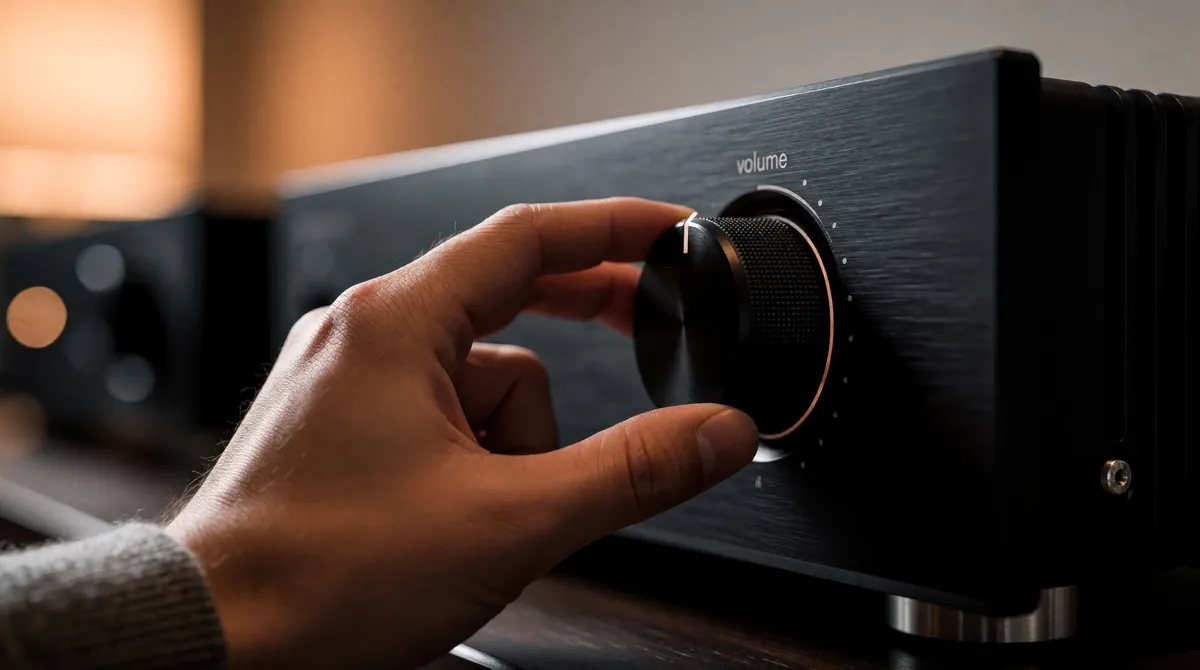
The ever-important volume is controlled here by an Alps RK27 potentiometer (the popular blue velvet), motorized so it can be operated remotely. The remote control, with a metal surface, also controls source selection, which works via quality relays and is indicated on the amplifier's own control by a soft amber light. The front panel also lets us select the direct input to the amplification stage, or let the signal pass through the bass, treble and balance circuits. And, of course, there is a selector for recording control (best left off unless we need it).
Compared with the previous flagship (PMA-SA1), this 2010 maintains the high build standard and only loses that model's very special potentiometer (an exclusive metal-encapsulated design which, incidentally, does not allow remote control), contributing instead of a single toroidal transformer this two-transformer idea, which, incidentally, the new mid-range integrated in the range (PMA-1500) also inherits.
TEST
I have already told you how revealing it was to analyze the Denon PMA-2010 inside. The time had come to see what it can do in its role of amplifying the signal from our sources to drive a pair of loudspeakers.
For most of the test I used an intimate system (Merlin TSM monitors in a large, optimal room), although I also had the chance to pair it with the 802Ds in the main system. I won't wait to reveal the excellent impression this integrated amplifier made on me from the very first moment; as the headline says, it has been a real revelation. In particular with the monitors (which are a true reference in their field), the synergy achieved (I don't much like that word, but here it fits like a glove) is outstanding. It truly keeps you glued to your armchair, and the advantage of using a music server (without having to get up to change discs) means that minutes and hours go by as we compulsively browse our music library, impressed by how well the system handles every kind of music and recording.
This, believe me, is not at all common. Many combinations manage to excel in some areas but stumble or don't shine as much in others; let me give you some examples. The most common is the amplifier that moves us with a small vocal jazz group but is unable to keep up with the crescendo of a large symphony orchestra. There are also those that reproduce the notes of a double bass solidly, that is, they seem to offer good bass, but then fail to keep time with a drum kit or a synthesizer (they don't get our feet tapping). And there are those that delight us with every micro-detail of a violin's strings or the resonances of the recording venue, but then punish us with aggressive or sibilant recordings.
On my first listen, the latter was my fear with this Denon, because the clarity of its reproduction immediately catches your attention. It seems to illuminate the soundstage; it really is as if we had drawn back the curtain on a window to let the sun in. We are struck by the doubt as to whether that might later turn into some aggressiveness, a doubt that is quickly dispelled, although I left it playing for a couple of days to give the internal components a minimum of break-in. The Elna Silmic capacitors in particular need at least a hundred hours and continue to improve beyond that, but I am very clear about what this Denon offers and I know that from here it can only get better with more use.
As I mentioned earlier, the combination of this PMA-2010 with the monitors is nothing short of magical. That system (speakers and room) offers a fabulous soundstage, and the Denon not only placed no limits on its width or depth, but brought a disconcerting precision. I confess I never thought that this unit could be so precise, nor indeed any unit with potentiometer volume control (always less precise in theory than a stepped attenuator). But whether because of the quality of the power supply or the circuit designed by Denon (a single transistor per phase and channel), I would certainly single out as the PMA-2010's greatest quality its great precision in locating the virtual sound sources within the soundstage. That localization is helped by the clarity mentioned above, which was not lost with further break-in, although it did gain in smoothness, the Denon losing the incipient traces of aggressiveness it may have shown in its first hours.
If we switch off Source Direct (the signal then passes through the tone and balance circuits), a touch of aggressiveness does appear in voices and high frequencies, and above all, if the system is offering as good a soundstage as was the case, a slight compression of the sound image can be heard, especially in depth (the foreground moves back a little and the background is less distant). In return, this allows the bass and treble to be adjusted (upward) to compensate for a low listening level when necessary, to very good effect. However purist we may be, there are times when the volume must be kept very moderate, and having that help compensates for the loss of perception of low and high frequencies our hearing suffers under those conditions. Here we can do so, or choose purism (at higher volume), at the press of a button. I was left wanting to try its phono stage, something I will certainly do, even if I have to set up the turntable in the monitor system to do it.
The sonic profile (without adjustments) is neutral, with the lower part of the spectrum well present (it does not recede in relation to the so well-lit upper mids and treble). Its ability to deliver current is beyond doubt, as I verified with the 802Ds, far more demanding than the monitors due to an impedance curve that becomes practically a short circuit at low frequencies, but which this amplifier drove without any problems, as shown by the fact that its temperature barely rose. I was surprised, incidentally, that it hardly heats up: after half an hour switched on it stays lukewarm, and after an hour of loud music it barely changes, rising very slightly with lower-impedance speakers, but it is certainly not a unit that requires ample ventilation.
CONCLUSION
Denon has managed to surprise me with the build standard of this amplifier, the design ideas used in it and, of course, the result. It had been a long time since a component kept me glued to my armchair for so long rediscovering my music library, and I know I am going to miss it when it is time to return it to the importer, even though I have very high-level alternatives to take its place.
I am left with two questions: how it will behave with speakers of a more aggressive character (the monitors have a sweet silk-dome tweeter, and the 802Ds are not far behind with their diamond one), and whether its "rated" 80W (I'm sure it actually delivers more) might fall short in very large rooms with very low-efficiency speakers (I never missed more power, even at levels beyond the reasonable). But even with those two questions, I am absolutely clear that this is an amplifier that deserves a place of honor among the best on the market.
There are a few that are better known (and considerably more expensive), but not better, and for its price there is nothing inside this PMA-2010 that makes me think the brand could have done it better: it has my full recommendation.
WE LIKE
- Very high-level sound.
- Solid construction with quality finishes and top-tier components very rare in this price range.
- Well-thought-out circuit, from the power supply to the minimalist output stages.
- Very complete connectivity and features, with MM/MC phono.
COULD BE IMPROVED
- Acceptance of a balanced (XLR) input.
- Lower gain in the preamp section.
- Higher maximum power.
SINCE 1910...
There are probably few music and sound enthusiasts who don't know the Denon brand, but perhaps not as many know its origins in the 1930s, when it was devoted to developing sound reproduction on records, from recording to the manufacture of discs and cartridges. In fact, it built the first lathe for recording (cutting) records in Japan, in 1939.
But the company had its roots even further back in time, since part of it was Nippon-Columbia, founded in 1910 and already devoted to recordings and gramophones. Later, during the 1960s, this industry boomed and Denon began manufacturing and selling all kinds of components, from cartridges (that period, in 1963, saw the birth of the DL-103, still popular and highly regarded today) to loudspeakers, as well as amplifiers and tuners, always with a professional range alongside its consumer components.
From then on, the company's history runs parallel to that of the industry. The first professional digital recorders appeared in the late seventies, then Compact Disc players, and later, in the eighties and nineties, amplifiers and receivers for home theater... And so we arrive at the present day, when Denon is recognized as one of the leading brands in audio and also in video, where its DVD players at the time set the pace of the industry's progress on the road to today's high resolution.
Denon PMA-2010AE, Revelation
Specifications
Stereo integrated amplifier with 6 line inputs, 1 Phono input and two recording outputs; preamp output (always active) and direct power amp input (selectable on the front panel). MAXIMUM OUTPUT POWER 80W per channel into 8 ohms (with less than 0.007% THD between 20Hz and 20kHz), 160W per channel into 4 ohms (less than 0.7% THD at 1kHz). POWER CONSUMPTION 310W. SIGNAL-TO-NOISE RATIO 108dB (line inputs) and 74/89dB (phono input in MC/MM mode). LINE INPUT IMPEDANCE 47kOhm (Source Direct Off) or 23kOhm (S.D. On). PHONO INPUT IMPEDANCE 47kOhm (MM) or 100 Ohm (MC). POWER AMP GAIN (Power Amp Direct input) 29dB. INPUT IMPEDANCE 47kOhm. Bare wire or 4mm banana outputs for main and secondary speakers. DIMENSIONS 434 x 181 x 435 mm. WEIGHT 24 kg. DISTRIBUTOR Gaplasa (917482960).
Price: €1,999
Keep reading
Yamaha DSP-Z11, Simply brilliant
DTS AND ITS EXTENSIONS With all the advantages that come with integration, it will amply meet the expectations of a broad range…
Dared MP-30B, The pleasure of tubes
The Dared MP-30B is a high-performance design at a truly irresistible price. Price: €1,125 Specialists' rating: 5 Text: Ramon…
Vincent TAC 88, Tubes with nostalgia
WHAT MAKES TUBES SPECIAL Vincent gets the very best out of the well-known KT 88, in an attractive retro design. Price: €1,520…
Dared VP-80, High performance
Dared's DV-80 is an excellent push-pull tube amplifier. It offers the quality of this kind of equipment with almost no…