The best digital connection: coaxial or optical?
One of the classic debates in this hobby is which type of digital audio connection is better. Read our opinion in the following article.
One of the most common questions for any newcomer to the hobby is which digital audio connection to use. We find ourselves with a DVD-Video player with an S/PDIF coaxial output and an EIAJ-TosLink optical output, with no further information other than the fact that both offer "digital sound". Fortunately, most A/V receivers and preamp-processors have both coaxial and optical inputs, so the practical problem disappears. But we can't help wondering what the supposed differences between the two connectors are, or rather, why are they both there?
On the Internet it is easy to find various arguments defending the pros and cons of each solution. Some of the premises used are of rather dubious accuracy, but there are others whose reasoning will make more than one reader think.
In the following article we will define what both connections are and what their advantages and drawbacks are (if any). The upshot, as we can already tell you, is that the choice comes down to a couple of purely practical issues.
S/PDIF
The acronym stands for Sony Philips Digital InterFace and, as you might expect, it is a standardized format developed jointly by Sony and Philips. This format allows audio files to be transferred in the digital domain, thus avoiding any digital-to-analog and analog-to-digital conversion during data transfer between a source and a processing system. All A/V receivers and amplifiers, unless we activate "source direct" (that is, a signal path that bypasses all processing circuitry), usually carry out various audio processing tasks (bass management or DSP, for example), and the vast majority rely on digital technology to do so. It therefore makes sense to use a link between source and receiver or processor that does not involve a converter since, as we know, every conversion adds distortion to the signal, however imperceptible.
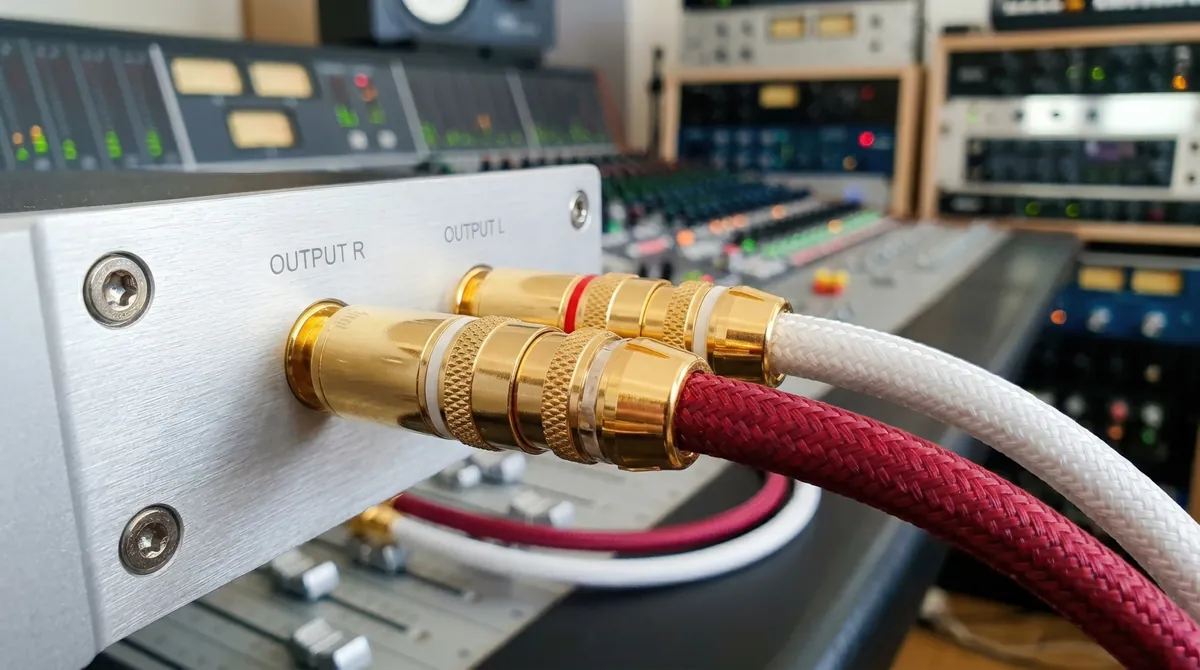
The S/PDIF standard is published in the Red Book, the set of specifications relating to CD-Audio. In fact, a good number of CD-Audio players (and especially CD transports) have this digital audio output (although they rarely also include an optical output). This protocol calls for a shielded copper cable with an impedance of 75 ohms, which keeps costs down. This is also why we speak of "coaxial", since it is the same cable used for video connections. The standard ensures proper transfer over runs of up to 10 or 15 meters (depending on the quality of the cable).
S/PDIF is compatible with IEC61937 standard bitstreams (which include multichannel audio in MPEG-2, AC3 -or Dolby Digital- and DTS). When these bitstreams are transmitted, the bits that normally carry audio samples are replaced by data bits from the original stream and S/PDIF signal headers. More data therefore travels down the cable than is actually contained on the CD or DVD. The header information is essential since, in addition to correcting any problems that may arise during transmission, it adds useful information, such as a bit that defines whether what is being transmitted is data (MPEG-2, DTS, AC3, etc.) or audio. This bit is important, as it prevents the digital "sound" of a DTS or Dolby Digital bitstream from being amplified by mistake.
EIAJ-TosLink
The name combines two acronyms. The first, EIAJ, stands for Electronic Industries Association of Japan, while TosLink is short for Toshiba Link, indicating that its development was promoted by Toshiba. This is another standardized format for transmitting bitstreams, in this case over an optical link. Instead of transmitting an electrical signal, it uses a very basic principle: either there is light or there isn't. Contrary to what many people think, the light beam is produced by a simple red LED rather than a spectacular laser. It also uses a square connector with a 3.5 mm link and optical fiber 1 millimeter thick. This format is very easy to describe: it is the optical version of S/PDIF.
Which is better?
Clearly, the aim of S/PDIF is for the digital data stream transmitted to be identical to the digital data stream received. Since EIAJ-TosLink is complementary to S/PDIF, it shares the same goal. In fact, for the most part this is always achieved, with the exception of jitter problems (timing fluctuations in the digital audio signal that reduce audio dynamics, compressing the soundstage and significantly raising the noise level). Does a TosLink connection avoid this problem? No, since part of the emitted light returns to the source, causing slight jitter problems.
So, on paper, is the transmission system the only difference between the two? Indeed it is, since whether by electrical or optical means, the digital information is exactly the same.
If every conversion adds distortion to the original signal, does the electrical/optical and optical/electrical conversion required by the EIAJ-TosLink connection alter the original signal? If we review the basic stages of any CD or DVD player, do we accept that the pickup itself already alters the quality of the signal stored on the disc? A laser retrieves the bits from a disc and converts them into an electrical signal. Since we are working in the digital domain, the data is reduced to two possible values: 0 and 1. Therefore, as long as there is no signal processing, electrical-to-optical conversion (and vice versa) need not be a problem.
Some people claim to hear noticeable differences between an S/PDIF link and an EIAJ-TosLink link. We have tried it and have not found any appreciable difference. Some justify it on the grounds that certain copper cables have difficulty transmitting sounds of different frequencies in time. This might perhaps be valid for analog sound, but not when what we are transmitting are stepped bitstreams, always at the same frequency and with the same dynamic range (for example, 44,100 samples per second with a range between 0 volts for the value 0 and 5 volts for the value 1; it is the exact combination of zeros and ones that allows a low-frequency sound wave or a high-frequency one to be derived). In fact, with that last sentence we have already told you which connection "sounds" better: both.
However, there are logical, objective and practical reasons that may lead us to use one connection or the other. Dolby Laboratories, for example, states on its website that the ideal is to use the coaxial or electrical S/PDIF connection. As we have said, it uses a cinch (or RCA) connector with a 75-ohm coaxial cable (so it is not the same cable we use to connect the analog outputs of a player and a receiver). If both the connector and the cable are good, the only drawback that can be attributed to this type of connection is unwanted electromagnetic fields. Electrically, the signal passing through the coaxial cable can be altered if there is a sufficiently strong electromagnetic field. In such a case, the error-correction codes would be insufficient, generating annoying noises (but never varying equalization, loss of bass or shrill treble).
The optical link is completely immune to electromagnetic fields, making it suitable for electrically polluted environments. On the other hand, it has quite a few more drawbacks. If we said earlier that S/PDIF is reliable up to distances of between 10 and 15 meters, it is only fair to mention now that for distances greater than 2 meters EIAJ-TosLink can be unusable (because of internal reflections). Another major shortcoming is that the vast majority of optical fibers do not tolerate 90-degree bends, making them rather inflexible cables. If the fiber breaks, it is very likely that the light will not be transmitted. Another problem, perhaps the most decisive, is the poor quality of the connectors and, alongside it, problems related to dirt: a single speck of dust (the buildup of grime over time) can prevent the light from the red LED from reaching its destination.
Keep reading

Bi-amping: a remarkable improvement
One way to upgrade your system is to bi-amp it. Learn about the methods, advantages and drawbacks of this type of configuration.

EVD: A sandstorm
On November 18, 2003, a news story shook up the market: China was proposing a high-definition format that outperformed DVD in…

Why bass reflex?
We are used to talking about bass-reflex and conventional loudspeakers, but we are seldom aware of what this actually means.
The importance of a scaler
An article explaining the different processes a video signal undergoes before being projected.