Vincent SA-T1 and SP997, Back to the future
WHY SEPARATE PREAMP AND POWER AMP?
- The rise of tubes and technical sophistication come to us courtesy of Vincent.
- Price: €2,360
- Specialists' rating: 4
- Text: Jorge Wuhrmann
The Vincent brand, German-designed and Chinese-made, has earned a good name among enthusiasts in a relatively short time, thanks to the excellent value for money of its products. On this occasion, in response to growing demand from many enthusiasts to raise the stereo quality of their systems, we turn our attention to a pairing of a tube preamp (SA-T1) and solid-state power amplifiers (SP-997).
The best of both worlds
As we mentioned in our previous issue, the vacuum-tube-based side of the audio industry has been experiencing something of a revival lately, to the point that we know of components not produced for decades that have recently gone back into production. It is a product of the times, in which two things converge: on the one hand, specific demand for a certain sonic (and, why not, physical) aesthetic, and on the other, the existence of fully operational factories in countries of the former Eastern Bloc or the Far East that are able, today, to supply the components at a reasonable production cost for the relatively low number of units manufactured.
This time we are dealing with one of the combinations most applauded by many sound experts: a tube preamplifier and solid-state power amplifiers. In theory, this combination brings together the advantages of tubes in terms of smoothness, control and sweetness of timbre with the greater bass precision (lower distortion) of transistor electronics.
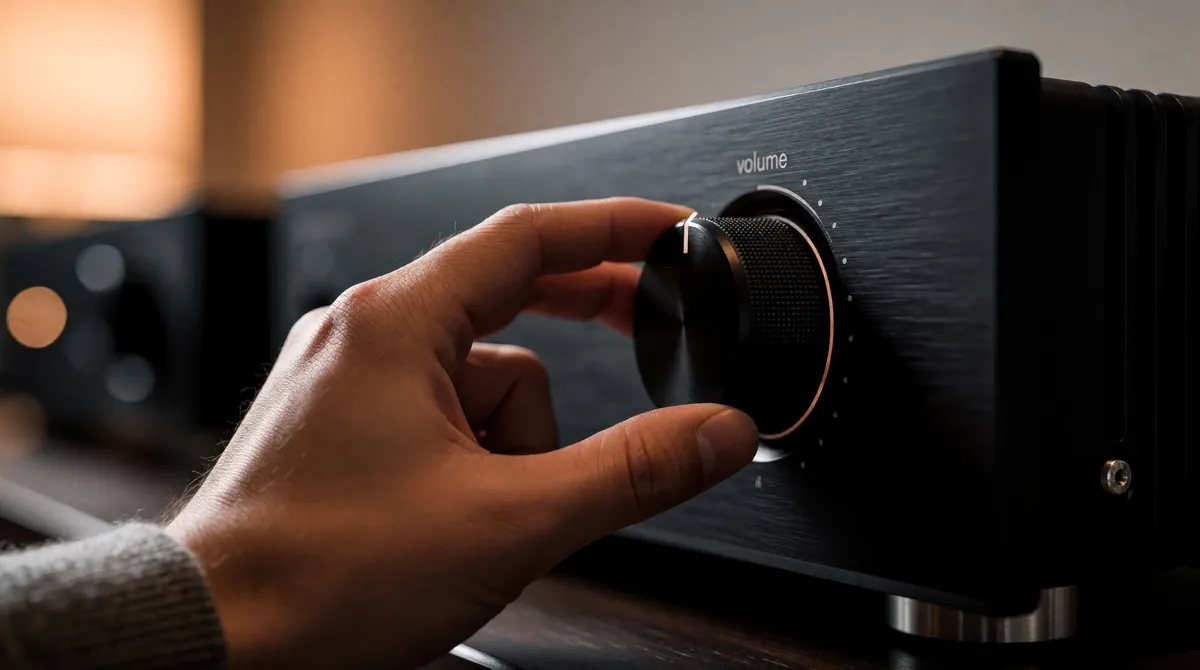
In the case of the SA-T1 preamp, we have a unit fitted with 12AX7 and 12AU7 tubes whose styling is clearly inherited from decades past. It has a round window on the front through which one of the four tubes can be seen glowing amber, mounted behind a 10 mm-thick aluminum front panel that conveys a strong sense of solidity. However, the retro styling fortunately does not mean a totally minimalist design in this case, and we find support for up to six line inputs and a recording loop, as well as an ALPS volume control with remote control. A real point of difference from incomprehensibly more austere tube designs.
But are we dealing with a tremendously purist unit? Judging by its construction and use, yes. However, the presence of a button to engage or disengage the tone bypass and a loudness button (a system that boosts low frequencies at low volume) makes one think more of a return to the past than anything else. A return to the past because it has been many years since I last saw loudness, or bass and treble controls, on a unit designed by and for pure stereo. Personally, I would have preferred a pure direct input allowing the unit to be integrated into a home theater system, something not exactly easy to find nowadays and which many enthusiasts would appreciate more than those forms of equalization.
On the rear panel we find good Teflon-insulated RCA connectors of excellent quality, but there are no balanced connectors, something desirable in a unit of this kind.
The SP-997 monoblocks offer an interesting 150 W into 8 ohms and provide connectivity via both balanced and unbalanced connectors, and they allow automatic power-on when connected to the same brand's SAV-C1 A/V preamp.
Tests
Using my usual SA1250 loudspeakers and a Toshiba SD900-E DVD-Video/Audio player, I listened to a selection of tracks to try to gauge the quality of our group of guests, though not before allowing a reasonable 20 to 30 minutes for the system to warm up. From the start, the sensations I had recently experienced with a superb tube integrated amplifier seemed to return, albeit in a subtly different way. The soundstage seems to have more depth, as I recently noticed with the Primaluna Prologue One, giving more of a sense of the voices being in the foreground relative to the accompaniment, as in the vibrant duel between Dianne Reeves's voice and Wynton Marsalis's trumpet on "Feeling of Jazz" from the album The Magic Hour, although with greater liveliness than pure tube amplification. Likewise, the guitar of the ever-brilliant Paco de Lucía, on "La barrosa" from the album Live in America, shows very well-defined instrument placement and timbres, separated from the background, without the latter losing any impact or power in the sextet accompanying him. Finally, with more ambitious orchestral forces, I found especially striking the power of the love theme from Cinema Paradiso, orchestrated by Ennio Morricone with the voice of Dulce Pontes, which opens the album "Focus"; or the version of Strauss's Four Last Songs by Kiri Te Kanawa with the Vienna Philharmonic under the baton of Sir Georg Solti. Here the delicacy of voices and timbres came together with all the dynamics needed to convey the emotion of the music, which the SP-997 monoblocks provided in abundance thanks to their generous current delivery. Even with much more electric material, such as the chill-out style of Jan Garbarek's latest work In Praise of Dreams, the sensations of impact, control and soundstage definition noted earlier are repeated, now combined with good control of a bass line strongly marked by its electronic origin.
With a very interesting musicality, the Vincent SA-T1 and Vincent SP-997 preamp/power amp combination will provide music lovers with many hours of enjoyment. With enough power to drive a varied selection of loudspeakers, it could become an interesting stereo alternative, our main objection being that it cannot easily be integrated into a home theater system; even so, we still recommend an audition.
WHY SEPARATE PREAMP AND POWER AMP?
As we have mentioned on other occasions, the reason why we can obtain better performance from preamp and power amplifier setups than from integrated designs lies in the power supply. By separating the power supply of the preamp from that of the amplifier sections of each channel, the aim is to avoid all kinds of "bottlenecks" and interference in the power supply that could degrade the signal. However, with careful design and a generously specified power supply, an equally good result can be obtained in a single chassis. In reality, this is one of those old battles between enthusiasts who favor one approach or the other, in which there are usually no winners or losers, only personal preferences.
Vincent SA-T1 and SP997, Back to the future
Specifications
SA-T1 Preamp
Frequency response: 20 Hz to 20 KHz (+/- 0.5 dB).
Output voltage: 2 V. Signal-to-noise ratio:
90 dB. Input impedance: 47 kOhms. Dimensions and weight: 430x95x365 mm, 8 kg.
SP-997 Monoblocks
Frequency response: 20 Hz to 20 KHz (+/- 0.5 dB). Output power: 150 W into 8 ohms. S/N ratio: 95 dB.
Dimensions and weight: 160x268x225 mm. 6.5 kg.
Distributor:
Sarte Audio Elite
(963534395).
Price: €2,360
Keep reading
Marantz AV8003, Vivaldi and Indiana Jones
ABOUT THX The AV8003 is a superb exponent of the musical purity Marantz has upheld through thick and thin since its beginnings…
Denon DVP-602CI, A power boost
WHAT IS VIDEO NOISE? The Denon DVP-602CI is a product for videophiles who are not satisfied with "good" and are willing to go a…
Rotel RSP-1068, When very good doesn't have to mean expensive
With the RSP-1068, Rotel offers a preamp-processor equipped with the latest decoding and extraordinary features, more than…
Rotel RC-1082, With a touch of nostalgia
PREAMPLIFIERS The RC-1082 has such transparency, precision and, in short, respect for the signal that if something cannot be…