Rotel RC-1082, With a touch of nostalgia
PREAMPLIFIERS
- The RC-1082 has such transparency, precision and, in short, respect for the signal that if something cannot be heard, it is because it is not on the recording.
- Price: €1,000
- Specialists' rating: 6
- Text: Luis LLANA
With the Michi series of the 1990s, the emblematic Japanese firm Rotel demonstrated sufficient technological capability to embark on major projects at realistic, though not cheap, prices; in other words, the kind of components that let us reach great heights of musical excellence and knock on the doors of Olympus without having to mortgage the house.
Probably for commercial reasons, that series was dropped and discontinued, a practice that spread to other renowned Japanese manufacturers, which devoted their resources to making more down-to-earth products. But Rotel acted intelligently, and many of the technological developments for the Michi series (later called High End by the manufacturer) were inherited by its lower-tier products: the then 900 series was strengthened and Rotel launched high-quality products at a very competitive price, whose natural evolution has been its current, complete and competent 1000 series, to which the unit we present here and now belongs: the RC-1082 two-channel preamplifier.
It is the eldest of three siblings (one of them the minimalist RC-06 preamplifier from the 06 series) and bears the unmistakable stamp of the 1000 series, with a front panel made of cast white metal, flanked on both sides by handles, supposedly for carrying, in black anodized aluminum, attached to a second, 9 mm-thick panel of the same material and color that supports the whole. In other words, robustness in abundance and a simple but impeccable internal construction, with the strict number of components needed for the unit to do its job without compromising signal quality, and a battery of relays for switching the inputs, mounted on a large board that occupies the entire base of the unit.
The excellent power supply stands out, oversized for the energy needs of a unit of this kind, with a large toroidal transformer and four capacitors of no less than 4,700 microfarads each, all five components made by Rotel and the capacitors "made in United Kingdom", according to their printed markings.
The RC-1082 is a comprehensive preamplifier, with seven unbalanced line inputs on the rear panel via RCA connectors and an eighth input on the front via a 3.5 mm stereo jack, labeled Media Player, intended for MP3 players and iPods, although to all intents and purposes it is a conventional line input. And the crowning touch: a phono input that accepts a turntable fitted with a moving coil (MC) or moving magnet (MM) cartridge, whose selector switch is on the back of the unit next to the phono input. According to Rotel, the circuit for this input is derived from the one used in the RHQ-10 phono preamplifier from the aforementioned Michi series, but judging by its implementation, it is not hard to see that it is a simplified version of the one used in that legendary and exceptional unit, a true benchmark in its day. Nevertheless, I was able to confirm its superb behavior in the listening tests, with an excellent overload margin. Rotel has not forgotten those nostalgic for tape recording, and the RC-1082 offers excellent old-school operational flexibility, like the preamplifiers of the heyday of open-reel tape recorders or three-head cassette decks: two of the inputs have a loop for monitoring the recording, but it is also possible to listen to any source while recording the signal from another, for which the RC-1082 has two buttons per source, except Media Player, arranged in two parallel rows labeled Listening and Recording respectively, with a button to set Recording to off. There is an LED indicator above each button that lights up in a striking blue when activated, so a quick glance is enough to check how the unit is operating at any time.
Also as in those days, although in this case the more conservative music lovers will probably be up in arms, it has the typical separate bass and treble tone controls, something that seemed to have been definitively banished from high-end equipment. But it makes sense given the number of current recordings that are harsh and lacking in linearity, especially of modern music, because the sound engineer decided so on the basis of a misguided idea of "modernity". However, the boost and cut curves for the respective frequencies are very gentle to avoid phase shifts, and the circuits can be taken out of service with a dedicated button.
The clear proof that Rotel has paid great attention to detail with this sort of feature is found in the headphone socket, which lacks the horrendous switch that cuts the signal to the power amplifier when the jack is inserted. Instead, our Rotel acts elegantly and deactivates the signal from one of the two 12V triggers which, if so configured, keeps the power amplifier switched on, so the amplifier will switch off when the headphone jack is plugged in. If the system is not configured as Rotel intended, simply switch the amplifier off manually for headphone listening, and that's that.
But since nothing is perfect in this vale of tears, I could not find an HT Direct key or similar anywhere, which would make it easy to integrate the RC-1082 into a home theater system, so if needed you would have to resort to a good-quality source switching box for the main channels, although our star has gone halfway there with two preamp outputs. That is how yours truly has his stereo preamplifier connected to the home theater system, and it works like a charm with a switcher from the British firm QED, fitted with gold-plated contacts and connectors.
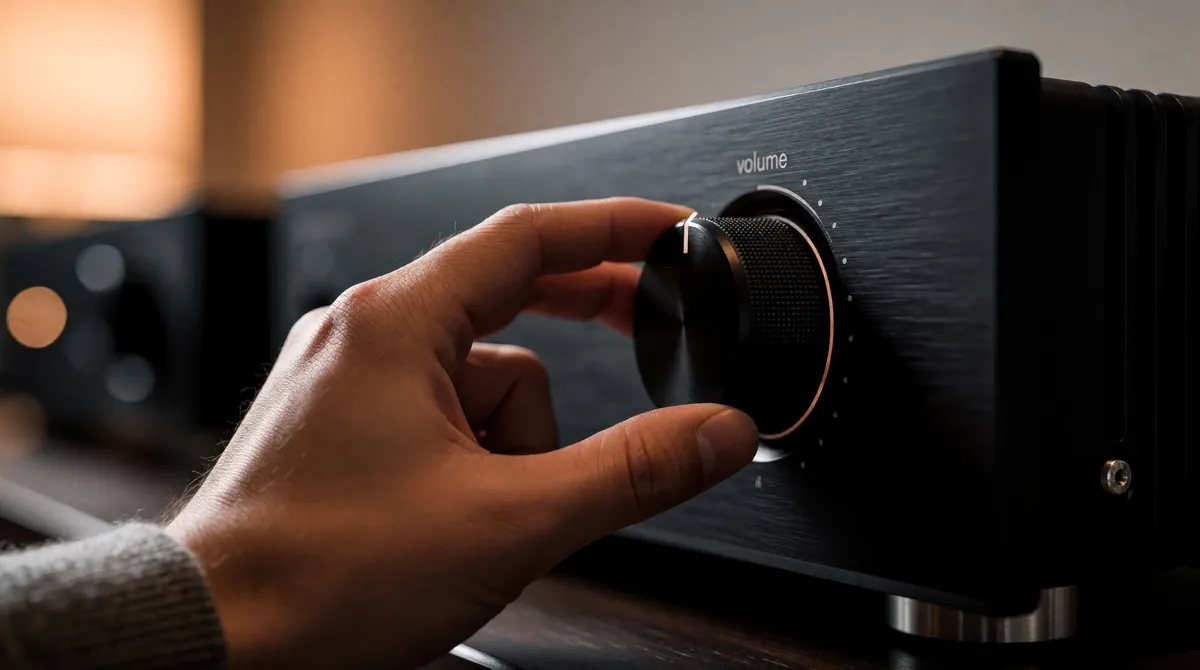
On the other hand, the power button only switches the unit to standby; there is no mains disconnect switch, and the solution for those who dislike the dreaded standby modes is to "pull the plug". All the indicators glow in a pretty blue, including the one marking the position of the motorized volume knob, with remote control of volume and of the RC-1082's main functions from a decent remote control.
As for the rear panel, the RCA connectors are of good quality, gold-plated (including the center pin) and free of suspicious sideways wobble when the cables are inserted. There is an input for an external remote control, to which any standard IR receiver can be connected, two IR outputs that send the incoming IR signal to other Rotel components, and the two 12V triggers mentioned, all with 3.5 mm jacks. An RJ-45 connector for controlling the RC-1082 from a personal computer running the appropriate software, a ground terminal for the turntable and the IEC connector for the power cord, without ground, complete the rear panel connections.
EXCELLENT, IN AN UNORTHODOX TEST
Let me digress to mention that there is a certain standardization in the values of preamp output and power amplifier input signals, so that pairing components from different brands should pose no problems, at least in theory. But practice says otherwise, and the best thing in these cases, to avoid taking risks, is to put yourself in the hands of a trade professional, or buy both units from the same brand and series, and even then, this is not an absolute truth. I should tell you that Rotel designed the input of its RHB-10 power amplifier, from the aforementioned Michi series, with a slightly higher sensitivity than usual, possibly so that pairing it with a passive controller (RHC-10) from the same series would be perfect. Rotel also made a line preamplifier, the RHA-10, which, together with the RHB-10 power amplifier, is part of my system. I use them for some of the tests for CEC.
You may think I am straying from the subject by telling you about components that are now history, but all this is relevant for two reasons: first, I believe this article would have been more revealing with a combination of the RC-1082 and a power amplifier currently in the catalog, instead of having to resort to my RHB-10, a formidable machine but out of production; second, because I was surprised that using the RC-1082 with the RHB-10 power amplifier is more comfortable, with a more progressive increase in gain, than with my usual RHA-10 preamplifier, with which I have to be more careful when turning the volume control. Who would have thought, since both units are from the same series, although it is possibly due to the different attenuation curves of the respective volume potentiometers: linear in the RHA-10 and logarithmic in the RC-1082. I don't think I am wrong in saying that there will be very few power amplifiers our star will not get along with, having seen its perfect match with the RHB-10, which is somewhat tricky due to its high input sensitivity (775 mV RMS for 200 W output per channel).
After listening to all kinds of recordings that are regulars in these tests, with my Marantz SA11-S1 SA-CD player connected to the RC-1082 via Van den Hul Integration cable, everything seemed as familiar to me as if I had done the tests with my usual preamplifier, the aforementioned Rotel RHA-10, a considerably more expensive unit than our guest, in terms of the old pesetas of the 1990s. The best compliment I can pay the RC-1082 is that it has such transparency, precision and, in short, respect for the signal that if something cannot be heard, it is because it is not on the recording, or the Marantz player has been hiding it from me, which I doubt. The phono circuits performed excellently with my Thorens TD520 turntable, MC cartridge and current 180 g vinyl, but owners of a good LP collection will no doubt prefer an external phono preamp connected to one of the RC-1082's line inputs.
A superb preamplifier at a more than interesting price, which I recommend without reservation, even to the most purist music lovers who may have frowned at certain details.
Andrés Marquez, Product Manager B&W. On behalf of B&W I would like to express our thanks for the brilliant article on our RC-1082 preamp. The points highlighted are in keeping with Rotel's Balanced Design Concept, namely an oversized power supply, selected components, circuit paths reduced to the bare minimum, build quality, ease of use and care for visual appearance. All of this results in sound reproduction without alteration and without loss of detail, allowing it to form part of any truly high-end stereo system.
PREAMPLIFIERS
Whether it is a standalone unit or built into an amplifier, the preamplifier is, together with the signal sources, the most critical component in the entire audio chain, because of the delicate signal it has to handle once the input source has been selected. Its voltage gain circuits raise this signal, of a few millivolts, to a voltage capable of driving the first stage, also a voltage gain stage, of the power amplifier, which then amplifies it in its current gain circuits. The quality of the electronic components is crucial, the fewer the better, as is choosing the shortest possible signal path. When the preamplifier and power amplifier are in separate chassis, their correct electrical matching in terms of voltage and impedance is of paramount importance, with relatively standardized values of between 1V and 2V, and low impedance at the preamplifier output, between about 40 and 100 ohms, to which the power amplifier presents a high input impedance whose values are usually between 30,000 and 40,000 ohms. Since I touch on it in passing in the article: a passive preamplifier has no power supply and no electronic circuits, so the signal level at the output is identical to that at the input when the volume potentiometer is set to the point of least attenuation. An input source selector and a series of resistors, all of the highest quality for obvious reasons, are all the components of a passive preamplifier, which should really be called a "controller", because it does not preamplify anything. Matching it with a power amplifier is very tricky, because the output voltage and impedance are dictated by those of the source. Its respect for the purity of the signal is total, and that is undoubtedly the strong point of this type of unit, which, however, suffers from a certain lack of dynamics.
Rotel RC-1082, With a touch of nostalgia
Specifications
TOTAL HARMONIC DISTORTION 20 Hz-20 kHz < 0.004%. INTERMODULATION DISTORTION 60 Hz:7 kHz, 4:1< 0.004% at 1V output. INPUT SENSITIVITY AND IMPEDANCE Phono MC, 0.25 mV/100 Ohms; Phono MM, 2.5 mV/47 kOhms; Line: 150 mV/18 kOhms. PHONO INPUT SATURATION MC/MM: 1.6 mV/16 mV. PHONO INPUT OVERLOAD MC/MM: 16 mV/160 mV. OUTPUT SENSITIVITY/IMPEDANCE 1 V/100 Ohms. FREQUENCY RESPONSE Phono: 20-20,000 Hz ± 0.2 dB; line: 4-100,000 Hz ± 0.5 dB; SIGNAL-TO-NOISE RATIO IHF A-WEIGHTED Phono MC/MM, 70 dB/75 dB; line, 100 dB. POWER CONSUMPTION 15 W. STANDBY POWER CONSUMPTION 2.5 W. DIMENSIONS 432 x 92 x 344 mm. WEIGHT 7.5 kg. DISTRIBUTOR B&W Group España (935894722).
Price: €1,000
Keep reading
Denon DVP-602CI, A power boost
WHAT IS VIDEO NOISE? The Denon DVP-602CI is a product for videophiles who are not satisfied with "good" and are willing to go a…
Marantz AV8003, Vivaldi and Indiana Jones
ABOUT THX The AV8003 is a superb exponent of the musical purity Marantz has upheld through thick and thin since its beginnings…
Lyngdorf DPA-1, The most desirable correction
DPA-1: an excellent preamp Another surprising proposition from Lyngdorf: its room correction built into a superb digital preamp…
Vincent SA-T1 and SP997, Back to the future
WHY SEPARATE PREAMP AND POWER AMP? The rise of tubes and technical sophistication come to us courtesy of Vincent. Price: €2,360…